Friday, April 23, 2010

Week #32 Japanese

An izakaya is the Japanese version of a tapas/pub grub kind of place, where people gather after work for a drink and a bite--or perhaps just a drink or two or three. So explained our friends, Jeff and Marilyn. They spent two weeks in Japan on their honeymoon and developed quite a fondness for this style of eating and drinking, and they wanted to introduce Himself and me to their favorite izakaya, Musha in Torrance. Seeing as Torrance is home to the US headquarters of two of the largest Japanese automakers, Toyota and Honda, we knew we were in for an authentic experience.

Small plate dining is great, because you get to sample a lot of dishes without the risk of getting stuck with an entrée you don't like, always a hazard of forging into new culinary territory. Most of my experience with Japanese cuisine has been in the realm of sushi and sashimi, so it was nice to try something different.
We started off with maguro yukke, a dish of tuna sashimi, so I began on familiar territory. Accompanying it were ribbons of nori and daikon radish, sliced green onions and a quail egg yolk for drizzling over it all. The rice cakes alongside were a high-end version of what we liken to styrofoam packing peanuts. These actually had flavor and a puffed rice texture that didn't remind me of styrofoam.
When I start a meal with some good sashimi, I'm hard pressed to want anything cooked. But I changed my tune when I saw the words "pork belly." Buta kakuni is pork belly with potato, boiled egg and a bit of broth. This is one of those occasions when I wish I'd been there by myself. I yearned to snatch the bowl and slurp down that rich, porky broth.
A total surprise to me was the takotama, an omelette, which turned out to be my favorite item of the night (and that's really saying something, considering there was pork belly on the table). I've never had an omelette like this one, with chopped octopus, seaweed, red ginger and Tokyo leek, and topped with a couple of sauces I'm sure they'll never divulge the recipes for. It's the kind of dish that can make you fake a celebrity sighting so you can snag an extra bite while everyone's distracted. "Don't look now, but I think that's Brad Pitt!" Gobble-gobble-gobble... (Hint: Always begin with the words, "Don't look now..." and everyone will do an immediate head spin, which will buy you a few seconds in which to pinch the good stuff.)
Then our server brought out a tiny tabletop grill, and we cooked our own gyu hire ponzu: beef tenderloin with chopped scallion, ginger and wasabi and a ponzu dipping sauce. Want it raw, rare or cremated? Cooking tabletop brings new meaning to that old Burger King jingle, "Have it your way..."
I wish the picture without the flash would reproduce better here--the charcoal glowed with the orange, purple, pink and gold of a sunset and looked really cool in the low lighting.
We were curious about the black sesame ice cream, which was technically sold out, so they brought us the final scoop of the evening, along with a scoop of vanilla. That was fine by me--I just wanted to know what black sesame ice cream was all about. It had a subdued flavor--I could only detect the musky black sesame essence on the back end as the ice cream warmed and slid down my throat.

Now, I'm back at home and would like to make something very basic, in the spirit of izakaya. I've decided on musubu, which reveals how simple and yet satisfying a Japanese dish can be. For the Japanese, rice is essentially sandwich bread, so when you tuck a piece of fish inside and give it a bit of seasoning, you have a Japanese sandwich.
 Musubu is bite sized, so you can make as many or as few bites as you want. It requires only three ingredients: rice, raw or smoked fish and goma sio or powdered seaweed. Cook some sticky rice and let it cool. Make bite-sized balls of it and into each rice ball press a piece of sashimi or smoked fish--I used smoked salmon. Then roll the ball of fish and rice in a sprinkling of goma sio for flavoring. I didn't have any, but furikake is similar, so I used that instead. Furikake is a mixture of seaweed flakes, toasted sesame seed and salt, with a tiny bit of sugar, soy sauce and green tea powder. Furikake is one of those seasonings that seems to be as ubiquitous in the Japanese kitchen as ketchup is in American one, sort of an all-purpose food enhancer.

 After Himself and I nibbled our musubu as an appetizer, we headed out to our favorite sushi place for dinner. The izakaya was great fun, but we were ready for our old haunt and a nice array of sashimi. Ah, comfort food, Japanese style...

Tuesday, April 20, 2010

Week #31 Salvadorian

If any food in inextricably bound to El Salvador, it's the pupusa. My pal Marina expounded on how much she loves pupusas until I finally gave in and teamed up with her for a trip to Mis Raices Salvadorian in Reseda to indulge in what is essentially the country's national food. The restaurant's name alone sings authenticity--it's Spanish for "My Salvadorian Roots."

Pupusas are essentially stuffed corn tortillas, but describing them this way downplays their specialness, sort of like saying the Mona Lisa is a picture of an Italian woman. The whole is definitely greater than the sum of its parts. The fillings are great all on their own, but they're insinuated into a package of corn flour dough that has great flavor and texture. They remind me a bit of the Colombian arepas, which are made of masa and some of which have fresh cheese inside.
Marina ordered a duo of pupusas, one containing finely chopped zucchini and the other, pork, cheese and bean--this is a classic pupusa called revueltas. The pork is called chicharon, which in El Salvador refers to pork that has been cooked and pulverized, rather like rillettes in French cuisine (in Mexico chicharone refers to fried pork skin). Quesillo, a soft cheese common throughout Central America, is the queso of choice. Revueltas has that ham-n-cheese thing going for it, but I just can't imagine anyone in the States putting beans on a sandwich. And that's a pity--if they're well seasoned and smashed, they'll both enhance a sandwich and help glue it together.
 Contrarian that I am, I decided to try something different, something from the day's specials, the flor de izote, that is, yucca blossom. The flowers were scrambled into eggs and tomatoes and served with rice and some really good beans. Everything on our table was pure comfort food.
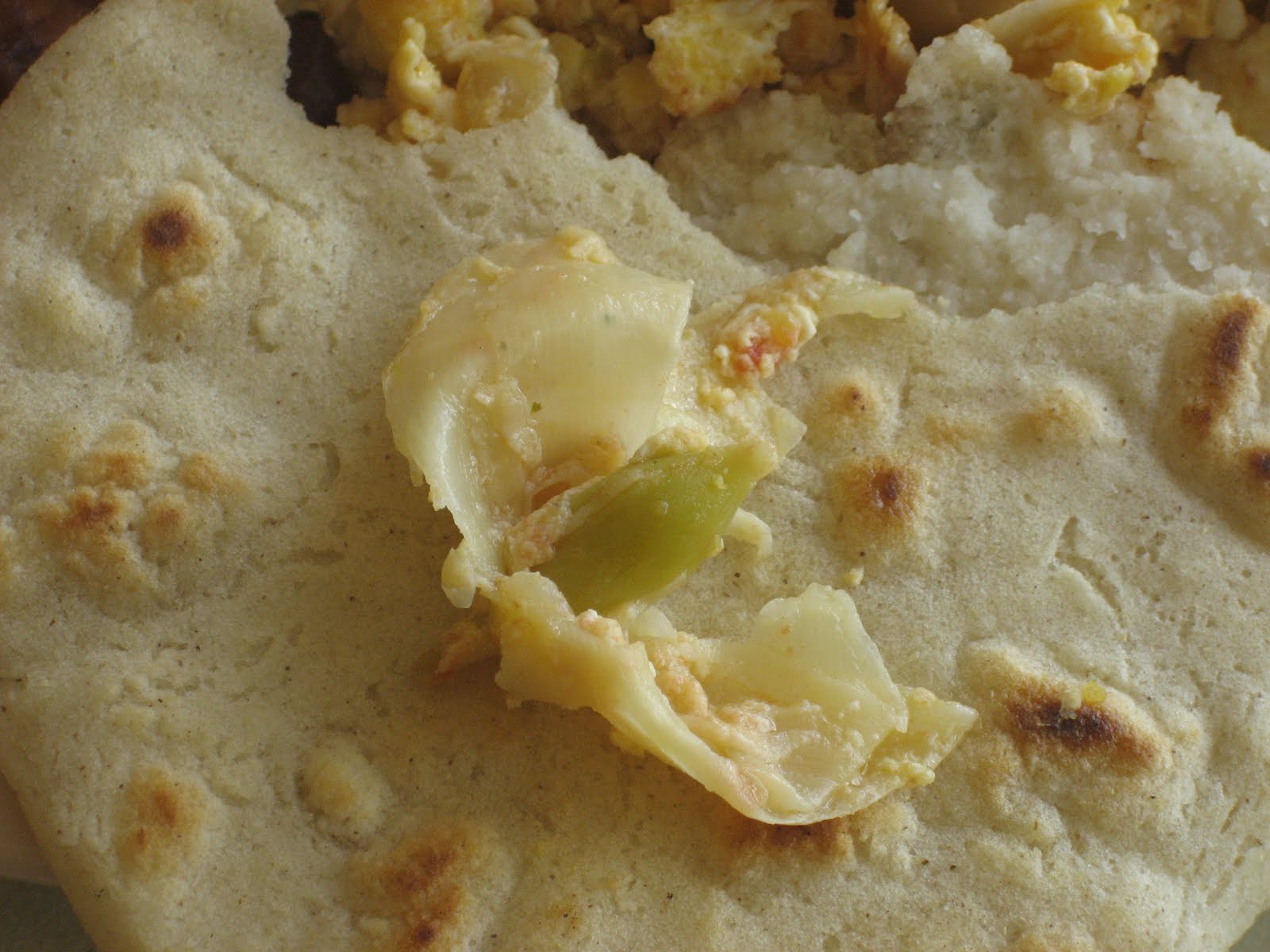
I dug out one of the flors de izote, to see what they look like. Not satisfied with this, Marina asked our server if we could see what these flowers looked like before they were incorporated into a dish.

She returned with a plate bearing a couple of the blossoms. The flors de izote on their own reminded us of the inner artichoke leaves that you don't have to fight with, delicate of both texture and flavor, and mildly tart and astringent.
 We both ordered cebada, a drink that is similar to a pink horchata. While horchata typically is made of either rice or almonds, cebada is made from barley and flavored and colored with crushed seeds of some sort, although our server didn't know what they were--and I've been unable to find out. No matter--it's tasty stuff, with the richer texture that makes these grain-based beverages so nourishing.

A few days later, this blog entry still isn't posted--and I have pupusas on the brain. So I told Himself to meet me at Pupuseria Del Valle in Burbank. One glance at the name, and there's no question as to their specialty. Himself agreed that these things are highly addictive. To the amusement of our server (I think she also cooked our meal, too), we ordered one of each of the seven types of pupusas offered on the menu: cheese; bean; revueltas again; zucchini again, although they call it Italian squash here; jalapeno; beef chorizo and cheese with loroco, another delicate flower. I can't name a favorite--they were all quite good. As for sampling any other foods, we just couldn't. We wanted to, but we succumbed to the lure of pupusas.
What can I say? This gringo was using a fork. Salvadorans eat these--curtido included--with their fingers.
Pupusas traditionally are served with curtido, a spicy pickled cabbage and carrot slaw that reminds me a bit of kimchi, and what I hesitate to call tomato sauce, because it's nothing like what we Westerners think of as tomato sauce. The red bottle in the photo was filled with a thin sauce made of tomatoes and peppers. A healthy pinch of curtido and an equally healthy squirt of the tomato sauce on any pupusa elevates it beyond its usual snack-of-the-gods status.

Embarrassingly--and unhelpfully to this blog--we both om-nom-nommed with the abandon of stray cats at a fish market and realized after the fact that we'd not singled out the loroco to inspect, as I had the izote during the earlier meal. Loroco is a similar tiny white flower that grows in Central America and that's often tucked inside a pupusa. I promise to go back soon and order a couple of loroco pupusas and pay attention next time!

I want to explore the wealth of other dishes I know Salvadorian cuisine offers, but as with tacos, pupusas are so particular and so beloved that I think it only fair to give them their own blog entry. The rest can wait for another day. Unless I once again succumb to the pupusas.

Tuesday, April 13, 2010

Week #30 Filipino

Encapsulate the cuisine of the Philippines in one brief blog entry? Fat chance! A nation spread over more than 7,000 islands and comprising the influences of countries both near and far--both friendly and conquering--is not so easily characterized. One look at the menu of Manila Sunset on Vermont Avenue at Santa Monica Boulevard reveals some of the myriad influences on the Filipino palate: lumpia and chopsuey are Chinese; adobo, lechón and menudo are Spanish; and bistek Tagalog reveals a blend of Spanish and local cooking styles. The native cuisine itself offers up plenty of pork specialties, including dinguan, a stew made of the organs and blood of the pig.

Himself and I wandered in on a Saturday, when the place was hopping with people who all seemed to know each other. As more and more came in, there were hellos and hugs and the pushing together of tables. We were the only Anglos there, so we felt we'd hit upon a good place to have a Filipino lunch and enjoy the swirl of the community around us.

I'd never heard of milkfish until this meal, but apparently it's quite popular in the Philippines--and throughout Southeast Asia--and on account of its remarkably bony structure, having it served de-boned is a huge deal. What arrived at the table was half a milkfish, grilled and served in its skin which had the consistency of soft leather.
Half of a Milkfish
...the left half!
 
tasty, tasty milkiness...
Milkfish is milky appearance but not texture. Still, it was moist in spite of looking rather dry, as much white fish does. While it had a delicate flavor, it stood up well to the grilling, as the char enhanced rather than masked its flavor. In fact, it's some of the best fish I've ever had.

Pork is popular on Filipino menus and always a winner with me, so I got the pork skewers.
mmm, pig-on-a-stick...
Like the fish, the pork bore a respectable amount of char. It was caramelized by the influence of fire and a lightly sweet marinade. We made our way through the meal with bite of pork--bite of fish--bite of pork--bite of fish...
 The egg drop soup was good, but nothing surprising. It was made with rice noodles and slivers of mushroom. Not to disparage it at all, but I'm always hesitant to fill up on hot soup when I can smell an amazing entrée heading my way!
Our dessert, bibingkang galapong, is a Filipino favorite that came to the islands by way of Goa on the west coast India. It's a somewhat custardy sort of cake made from rice flour, and it was actually jiggly! Baked and served in a banana leaf, it was topped with a fresh cheese that made the dessert interestingly salty and sweet. The freshly grated coconut on the side helped lighten its richness.
To drink we had (on the left) sago and gulaman, a sweet, syrupy palm-based beverage with soba balls and cubes of an agar agar-based gelatin, and (on the right) cantaloupe juice that was loaded with shreds of fresh melon. It was pretty sweet, so I'm betting there was some simple syrup in there, too. I get a kick out of both eating and drinking my beverage, so these were hits with me.

I'll certainly be back for more milkfish. I even want to try the dinguan (okay, so you don't have to). With a menu filled with options for both meat lovers and vegetarians, it looks like I have a lot left to explore.

Sunday, April 11, 2010

It's Songkran: Happy Thai New Year!

This is the season of Thai New Year, or Songkran, and Himself and I went to festivals both this weekend and last, to soak up the atmosphere and enjoy some really good walking around food. As I said in a blog entry after my recent trip to Thailand, the Thai are big on snacks, so going to a Songkran festival means lots of opportunities for incredibly good munching.
Meat on a stick is wildly popular, just like it is at your average American festival and fair. We got (left to right) shrimp balls, Thai sausage, squid balls and chicken. These treats don't sit around under heat lamps for hours, growing funky as they wait for someone to buy them. They're fresh and hot when you get them--which sometimes means a little wait. But it's fun talking with others in line and finding out what they're ordering and what their favorites are. The Thai sausage is my favorite--and the rate at which it sells out tells me it must be everyone else's favorite, too.
Papaya salad is tricky stuff. After you've had enough hot food you think, "Mmm, papaya salad. That ought to cool off my burning mouth." And if you think that, you're wrong! Papaya salad will make you cry for your mama. It's really good, crisp and refreshing--made from unripe papaya--but it can be punishingly hot. Considering how hot and muggy it gets in Thailand (think New Orleans in August), it's all about natural air conditioning--eat hot food, sweat and cool off. That wedge of cabbage to the upper right helps you cope with the salad's heat.
 We sampled plenty of sweets, too. The deep yellow you see in everything is made of egg yolk, a component of many Thai desserts (don't tell your doctor!).
These tiny pancakes are filled with a paste made of pandan leaves, green tea and coconut, then rolled.

The longest line we saw was not for snacks or papaya salad--although, believe it or not, papaya salad has quite a devoted following--but for crates of mangoes. Those smaller, gold ones that we call champagne mangoes here in the States--and pay dearly for--are one of the basic varieties of mangoes in Thailand, and the one Thais seem to miss most, hence the long, patient line.
 It wasn't all about the food, though. We stopped by and visited our friends at the Thai Tourism Authority and made the ritual observance, pouring water over the Buddha to bring good luck and prosperity in the coming year.
They presented us with wrist garlands called puang malai. I got really spoiled receiving these garlands while in Thailand. They're lovely and fresh and incredibly fragrant, made of rose buds, jasmine, gardenias and crown flowers. So nice to have in the car, in your hotel room or hanging from your wrist.

The incense wafting from the temple and from various altars scattered about the festival reminded me of those boat trips up and down the Chao Phraya River which runs through the middle of Bangkok. While the river is quite wide, so abundant was the incense being burned in temples on either side--and so numerous were the temples--that we could smell it all the way out in the middle!
The beauty pageant brought out some of the loveliest women I've ever seen. I'd certainly hate to be a judge at this pageant--what an impossible job! The variety of dress and adornment was as dazzling as the women themselves. (Notice the Latin food market in the background--and Thai Town interlaces with Little Armenia, too. LA truly is an international city.)
Every time we see these performers at Thai celebrations around Los Angeles, their routines and costumery are increasingly outrageous--but a lot of fun. Check out those huge boots beneath the pink flounces! Trippy, really trippy!

 Even more peculiar to me was the Thai woman in street clothes who hopped up on stage and sang "In Them Ol' Cotton Fields Back Home." Having come from the cotton fields of the South (while not specifically from Louisiana, as the song relates), I experienced quite a disconnect hearing it performed in this setting.

One reason I wanted to go to this second festival was because I found out there would be vendors selling Thai plants, and I've wanted a kaffir lime tree for a really long time.
Himself got the honor of toting the tree to the car. He was just a wee bit perturbed that I chose that moment to stop him in front of the temple for a picture. What?! Why wouldn't he want to pose whilst holding a tree?! More on kaffir lime later. Himself cautions me against making these blog entries too long. I just get carried away...!

Friday, April 2, 2010

Week #29 Sri Lankan

Sri Lanka (formerly known as Ceylon) is that tiny teardrop of an island that falls into the Indian Ocean from the eastern tip of India. It is a land of spices and curries, so if you like your food bland, best select a different holiday destination!

Himself and I visited Priyani Ceylon Fusion Oriental Cafe, just a stone's throw from UC Northridge. Our Sri Lankan host was proud of his cuisine and his cooking, and after he waxed poetic about the menu's offerings, we asked him to bring us what he thought we should have. He seemed quite pleased with our deference.
First he brought us a plate of appetizers or "short eats," all containing a filling of fish that was boldly seasoned but well balanced. On the left are pattis, which look for all the world to me like empanadas. In the middle are Chinese rolls (if only the fish sticks in school had been so good!) and to the upper right are cutlets. All were pleasantly spicy even without the homemade hot sauce--which pleased our tongues and cleared our sinuses.

"lump rice"
"Lump rice" isn't a very sexy name for a dish, but don't let that put you off. It's essentially an entire meal bundled up and cooked in a single banana leaf. Himself gently opened that steaming leaf to find eggplant curry, roast chicken, green banana curry, onion sambal and basmati rice nestled inside. I managed to swipe a few bites, but Himself guarded his meal jealously. I'll just have to go back and get my own next time. Everything in the leaf was tasty, but most surprising was the green banana curry. The dense, starchy consistency of the cubes of unripe banana had us puzzling for a few minutes. What kind of tuber is this? Or is it yucca? We finally went back to the menu and realized that the texture was so different from that of either ripe bananas and cooked plantains that we hadn't recognized it as banana. It's always puzzling when you encounter a familiar food that you can't recognize because of difference in culinary context.

Biryani
My biryani was made of basmati rice and loaded with cashews, raisins, currants and an array of spices. Buried inside this mound of rice were several pieces of roast chicken. (To my eyes it looks more like what I'd call "lump rice" than Andy's "leaf rice!") The biryani was topped with a roasted egg and served with a dense sweet eggplant curry on the side.
 "roasted egg"
It seems a little odd for a dish to show up with a twice-cooked egg perched on top (boiled and then roasted), but I'm finding that this is actually a common accompaniment for biryani. I'm also discovering recipes that call for deep-frying boiled eggs and making a curry of them.
 Watalappam
For dessert we shared a dish of watalappam, a custard flavored with an array of spices and a type of unrefined brown sugar called jaggery. It has a darker, more sophisticated taste from the jaggery and spices and plenty of richness from the eggs, cashews and coconut milk, so sharing a piece was smart.

Both entrees and the dessert are Muslim in origin, which might seem curious, considering that Sri Lanka is majority Buddhist and minority Hindu. But the history of civilization is the history of food, of food and food preparation methods being carried by immigrants, missionaries, merchants, armies and wanderers, so nothing should really surprise us when it comes to the culinary influences of one place on another.

Asian cooks know their spices like pianists know their keys. When a world of spices grows in your backyard, you don't have to shell out anywhere from $4 to the-sky's-the-limit for a single tiny bottle. So you can step out your back door, harvest freely and experiment to your heart's content to come up with the spice blend you like best. And every cook has his and her own favorite blend.

My friend and colleague Carol Selva Rajah shares one of her favorite Sri Lankan spice blends:
3 Tbsp. coriander seeds
1½ Tbsp. cumin seeds
1 Tbsp. fennel seeds
2 tsp. whole peppercorns
¼ tsp. fenugreek seeds
¼ tsp. cloves
¼ tsp. cinnamon
¼ tsp. cardamom
Dry roast the spices and grind in a small coffee grinder. Add chili powder and fresh curry leaves to flavor if needed.
Raw ingredients for a rich and heady spice blend: 12:00 cinnamon bark; 1:00 cardamom seed; 2:00 a bit of show-and-tell: smash these cardamom pods and you'll find those little black seeds inside; 3:00 cumin seed; 6:00 coriander seed; 7:00 black peppercorns; 9:00 fenugreek seed; 10:00 whole cloves; in the center, fennel seed which, incidentally, I got from my own garden right here in LA!

I toasted the coriander, fennel, cumin and cardamom seeds and then put everything in an electric coffee mill and gave it a good spin. I keep an extra mill on hand specifically for grinding spices--a metal one, as plastic absorbs the oils of the spices and imparts them on the next batch, even if you don't want that particular blend!
 Coriander seed toasting in the pan: Use an uncoated pan and medium heat, and pay attention, so they don't burn! Let your nose be your guide.
This may look like a lot of work, and you may give in to the urge to cheat and go buy a jar of pre-made curry or jars of pre-ground spices to make a curry (and who knows how long those jars have been sitting on the grocery shelf?), but if you take the time, you'll be rewarded with the most amazing explosion of flavors. And you can make this in large batches to use for more than one dish. Just don't make too much at once. As soon as these seeds are ground, they immediately start to lose their zazz.
The finished spice blend: If only you had a scratch-n-sniff computer screen!
  Throw a generous amount of one of these spice blends into a pot of simmering meat or vegetables, and the heat will open up the aromas and perfume your house with the most beautiful blend of fragrances imaginable. And of course, you'll have an amazing dinner, too.

Sri Lanka's wealth of spices lured many a ship from Europe in the 15th and 16th centuries. With all those neatly organized rows of tins and bottles of spices in the baking section of the grocery store at our disposal, it's difficult to imagine expeditions being prompted by the allure of something as ordinary--to us, anyway--as pepper and cinnamon. But the more I learn about spices and cook with those amazing blends, the more I understand what the fuss was all about!

*Special thanks to Carol Selva Rajah for her knowledge and insights. If you want to learn more about cooking with the abundance of spices and flavorings from Asia, look for her book, Heavenly Fragrance.

Wednesday, March 31, 2010

Do Not Soak This Pan!

....or you'll be throwing away the good stuff.

This is called tahdig, and it's about the most fun you'll have eating rice--sort of a rice crispy treat for grown-ups. In its purest form, tahdig is simply what is scraped out of the bottom of the rice pot. After you've dumped the cooked rice into a bowl, take a flexible spatula and work around the edges of what's stuck to the bottom of the pot, flip it over, sprinkle it with a little salt or any seasoning that makes you happy, and you have a great snack.
 The flipside: crusty and crunchy and fun to eat.

Tahdig traditionally was reserved for guests in Iranian households. But it's so popular now that it's on the menu in many Persian restaurants as a regular feature, meaning there must be some way to make it in quantity, right? Appliance manufacturers picked up on tahdig's popularity and began producing rice cookers especially for making tahdig.
Tahdig: recooked with butter

While I've found dozens of recipes for making it--the Internet is loaded with them--I cheated and made some by melting butter in a skillet, pressing some cooked rice into the bottom and letting it recook on low heat until the moisture was evaporated and the rice browned. Then I sprinkled it with a little southwestern seasoning and munched out.

We should probably keep this between us, you know? If the snack food giants discover how satisfying this stuff is, they're sure to waste tons of rice in the process of making a sad facsimile that is loaded with salt and devoid of character. But if you happen to have a particularly great method for making it, will you please share it with the rest of us? Thanks!

Tuesday, March 23, 2010

Week #28 Himalayan

"I'm sorry, we've run out of karma," is not exactly what you expect to hear someone say in a restaurant.

But Himself and I were at Tibet Nepal House in Old Town Pasadena, and the server was telling the people at the next table that one of the restaurant's Himalayan beers was out of stock.

No worries for us, because we were sipping Old Monk Super Beer and enjoying its smoky flavor. While our server called it a "heavy beer," it's what we in the States call malt liquor. Later I looked it up online to see what I could learn. The reviews were quite savage (one said it "smells like an old man's head." Yeesh! I'm glad I read this after I drank it!). I'm not a fan of malt liquor, but I suspect the problem was more a lack of context. Reviewers no doubt were picking up a bottle sitting on the back of a shelf in some specialty store--who knows how long it had been there?--carrying it home and tasting it without the benefit of the food it was created to accompany. Then there's the fact that this beer was produced in India and probably underwent repeated temperature changes en route to the States, which will ruin most any beverage or food. C'est la vie!, however you say that in Nepali.
Maasu Mo-Mo
We started our meal with maasu mo-mo, that is, steamed dumplings stuffed with lamb. With them came two sauces: a mint and cilantro sauce that was wonderfully fragrant, and a hot red sauce that contained some serious heat. Mo-mo is yet another example of those stuffed pasta-type items you find in cuisines all over the world. This Himalayan version is a popular between-meal snack.
Sekuwa
 Himself ordered the "house specialized platter" of Himalayan sekuwa, or clay oven-roasted meat. The platter contained a nice assortment of shrimp, lamb and two types of chicken scattered over a bed of sweet onions. The meats were marinated in a mixture of yogurt and regional spices and flavorings, which includes turmeric, cumin, garam masala, black pepper, cilantro and garlic. The blend of these flavors along with the bite of the yogurt and the smoky char provided by the clay oven made this dish worth gorging on. I'm convinced sekuwa could make a carnivore of a vegan, but then who's to say that treating veggies or tofu to the same flavor fest wouldn't make them equally yummy? It would be worth a try, but I'm sticking with the meat all the same.
Annapurna Yak: Looks a bit like fajitas without the tortillas, eh?
When there's anything as out of the ordinary as yak on the menu, you know I'm bound to try it. From among several options I selected Annapurna yak: pan-fried yak meat with green and red bell peppers, onion, tomato and Himalayan spices. This dish looks pretty much like fajitas, right? Wrap some up in a piece of naan, and you might just believe that. But the seasonings are quite different and the meat isn't beef, it's yak. Having sampled yak cheese a couple of years ago, I expected the meat to be rather gamy and strongly flavored, but this was not the case. Know how people often say of a meat they're unfamiliar with that it "tastes like chicken?" Well, yak is very beef-like in texture and flavor, which is mild, unlike the yak cheese and butter, which are often described as "rancid."
Chyamtange Dhopzi
Instead of naan we opted for chyamtange dhopzi, a flat, leavened bread made of finely stone-ground whole-wheat flour and baked in a clay oven. Himself deemed it a cross between naan and pita. It's crispy outside and soft inside and made without salt. While it doesn't open quite as easily as a pita, still, you can separate the layers and load it with bites of food if you'd like. Or use it to sop up juices, to dunk into dips and to push bits of food onto your fork.
Sho Jhaa, or Tibetan buttered tea
Sho jhaa, a Himalayan specialty, is buttered tea, traditionally made with yak butter. Since that's not so readily available in the United States, mine was made with regular cow's milk butter. It was rich, slightly salty and not at all sweet. Authentic sho jhaa is described as being almost broth-like, so rich is its consistency. When a butter as durable as that made from yak milk is emulsified into really strong tea, a few cups of the resulting brew will fortify you for whatever lies ahead in the frozen expanses of what is called "The Roof of the World."

If you've read Three Cups of Tea, you may recall Greg Mortenson talking about the necessity of taking buttered tea in this region. While the flavor and texture are curious, I have a feeling it's one of those things that, if you drank it every day, you'd miss it after you left. There's something curiously welcoming about it. I thought I might try my hand at making buttered tea at home, that is until I found that it involves boiling tea leaves for several hours and then incorporating the butter into the tea using a churn! I'd imagine that Himalayan households keep fires burning fairly constantly, and so have tea always at the ready.

I decided instead to turn my focus to making daal bhaat, the national dish of Nepal. Essentially it is a lentil soup served over rice, quick and easy to make, tasty and nourishing. I'm including the recipe at the bottom of this blog entry. As you can see from this photo, mine turned out rather stew like, but you can always add more liquid if you like to make it soupier.
Daal Bhaat
Our server clued us in on a few differences between Tibetan and Nepalese cuisines, the main ones being that Tibetan food is milder, while Nepalese is quite spicy. Rice grows easily in Nepal, so its dishes are rice based, while Tibetan fare includes noodles, since Tibet has little arable land for rice production.

It was interesting to hear our server outlining the characteristics that distinguish Tibetan and Nepalese cooking. To most of us, those points might seem insignificant. But to him, they were not. We all have our points of national and state pride. If you're from one coast or the other in the United States, it would be easy for the distinctions of different states or at least regions in the "flyover states" to blur, but to those of us who actually hail from one of those states, the characteristics that distinguish us as Southerners, Midwesterners and the like are quite pronounced. Likewise, the Himalayas may be the world's most formidable mountains, but the valleys that finger into them each hold their own distinctive culinary traditions.

As for our foray into Himalayan cuisine, our karma was very good indeed.


Daal Bhaat (lentil soup with rice)
4-6 servings

¼ cup + 2 Tbsp. mixed lentils
2 tomatoes, cored and chopped
1 medium onion, chopped
2 Tbsp. butter
chili pepper, minced, to taste (no particular type, so go with your instincts and taste)
a handful of fresh cilantro leaves removed from stems
fresh garlic and fresh ginger, minced, to taste
garam masala, to taste (you can use a store-bought version, but try making your own—for every cook who makes it there is a different version of garam masala!)

Wash rice (basmati is best and most authentic) and let it stand in the water in which it will be cooked while you prepare the lentils.

Boil lentils in 5 cups of water. Once they are cooked, after about 20 minutes, turn off the heat, stir in the garam masala and ginger (I use 1 Tbsp. of each) and set aside. Do not drain.

Melt butter in a medium-sized skillet and sauté the onion, garlic and tomato. Stir this mixture into the lentils, along with the coriander.

Cook rice according to directions on the package. Salt daal to taste, spoon rice into soup bowls and ladle daal over the rice.

*Because the cilantro and ginger are stirred in after the cooking is finished, their freshness brightens the earthiness of the lentils and the dense flavor of the garam masala.


Based on a recipe available from http://www.himalayanlearning.org.