Friday, July 16, 2010

Week #43 Argentinean

Whenever I hear someone say, "I could really go for some Argentinean food," I figure he--and 99% of the time, it IS a he who says this--is jonesing for a serious dose of red meat. After all, the most prevalent and popular of Argentinean restaurants are churrascarias, those meat-on-a-stick places.

But my vegetarian buddy Pat and I opted for something different. We headed for  Lala's in West Hollywood, where the menu was loaded with both meat and plenty of choices to satisfy the more vegetably inclined (yes, I know that's not a word, but sometimes you just have to make one up).
The first thing to hit the table is usually chimichurri, a great sauce for dipping your bread into or for drizzling over a steak or a serving of fish. The main ingredients are garlic, parsley, salt and pepper in olive oil. The choice of spices is at the discretion of the cook. It has a light, clean taste--but never hot--that tames the dense richness of all that steak. It's good over veggies, too.

Since somewhere around 60 percent of Argentina's population has at least a little Italian blood flowing through their veins, that country's influence on this cuisine is understandably pronounced. The Argentinean version of the frittata is the tortilla de papa, a potato cake held together with egg custard. This one is pretty basic, egg with potato and onion and a little chopped parsley over the top.

The provoleta is positively wicked. If not for a sprinkling of salsa, this would just be a skillet full of melted, crusty, chewy provolone, not that I'm complaining, mind you. You just have to focus on the salsa to convince yourself that what you're eating isn't flat out deadly! This is one of the most satisfying and decadent things I've had in a long time. I may have to return soon just for provoleta with a glass of wine--by myself, so I don't have to share (with apologies to Pat, Himself and anyone else who thought they might get to tag along).

Here's my entraña, the obligatory hunk o' beef, flanked by salad and rice. Sorry I'm not finding much to say on the subject, but it pretty much looks and tastes like Sunday lunch at most any restaurant in America--if I'd had it with mashed potatoes, which was an option. It was good, but there's nothing here that screams of a particular international cuisine. If I'd opted for the steak Milanesa, it would have been thinly sliced, breaded and fried, chicken fried steak style. Very familiar. Very American, Southern style.

Since I didn't make room for an appetizer or dessert, I decided to focus on those at home:
Some consider the official sauce of Argentina to be salsa golf, also known as salsa rosada, a combo of mayo and ketchup, plus other ingredients that vary depending on who you listen to.  Like chimichurri, it's a good all-purpose sauce. I know, some of you probably think a dip made of mayo and ketchup is a little on the low-rent side, but "dijonnaise" works and this does, too. It's especially popular in Argentina as a dip for palm hearts. I tried that, along with asparagus spears, carrot sticks and broccoli florets. It was all good.
 I even stirred in some chopped hard boiled egg and a few capers and made a yummy, though slightly pink, egg salad, a nice change from my usual.

Salsa rosada (I like that name better) is essentially one of those concoctions you mix things into until you like what you've got. The basic recipe I found called for twice as much mayo as ketchup, and then a bit of lime juice, Tabasco, salt and pepper. I added the tiniest bit of colatura (or garum or fish sauce, depending on which ethnic market you find it in). That realllly opened it up and enriched the flavor. A splash of caper juice instead of lime juice worked well, too. They sell it premade, in squeeze bottles like mustard, but as quick and easy as it is to whip up, and as easy as it is to make it exactly the way you like it, why settle for the store bought variety?

I've always thought fruit fools were the province of the English, but I keep running across recipes in Argentinean collections for mango fool. So that's what I made for dessert, fresh mango puréed with confectioner's sugar and lime juice, and some whipped heavy cream folded in (no, that tub of whipped topping from the grocery won't do--the cow is more trustworthy than the chemist in the milk fat versus partially-hydrogenated something-or-other debate). I spooned it into a glass with crumbled amaretti and slices of mango and topped it with toasted almonds. It gave me an idea--this purée would be a good replacement for the egg custard in tiramisu if you're making it for someone who can't eat eggs. Of course, there's still all of that heavy cream, so it's not a low-fat alternative, just an egg-free one.

While Pat had plenty of lunch without the meat, I remembered that my vegetarian friend Katie spent a few weeks in Argentina last year, so I gave her a call to find out how easy it was to do without meat in a country that, like the U.S., practically has a steak stitched onto its flag. Katie said the strong Italian influence meant there was plenty of pasta with tomato-based sauces to eat. She noted that Argentines are quite proud of their cheeses, so there was no shortage of protein. While Argentina produces some good wines, the national drink is maté, a type of tea that most people seem quite devoted to, so much so that Katie said the hiking trails were filled with people with a special apparatus strapped to their backs from which they sipped tea as they hiked. Curious!

I come away from this dining experience with the feeling that Argentinean cuisine is very much like our own. While there may be an overlay of other cuisines on our plate, America tends to be a strong meat-and-potatoes kinda place with a few regional variations, just like Argentina.

Tuesday, July 13, 2010

Mmm, Sweet Garlic Spears...

I just returned from a weekend jaunt to Seattle, where every farmers' market--not just the biggie in Pike Place--is offering garlic spears. They're the pre-flowering tops of the elephant garlic plant, milder than regular garlic, and milder still when they've had the heat put to them. And they are completely wowsome.
These grilled babies were smoky and delicate. The heads have the sweetness of grilled onion but without the heat (down toward the root end is where the attitude picks up). In spite of their gentleness, later in the day I found myself with a righteous case of dragon breath, so be warned if you're so excited about finding garlic spears that you hog them all for yourself.

To my knowledge we don't get them here in Southern California, but if I'm wrong about this, please set me straight and tell me where to find them. I yearn to bring them home by the armload like flowers, and see how many different ways I can prepare them. I'm sure they'd be great sautéed, chopped up and added to potato salad, or sprinkled over a plate of chicken livers or stirred into vichyssoise--or any soup, for that matter. Or grilled and tucked into a sandwich or left raw and dipped into bleu cheese dressing and munched on like carrot sticks.

Dang! I'm getting hungry for something that requires plane travel. Time to leave the keyboard and look for something to take my mind off of garlic spears. Time to book another trip to Seattle.

Saturday, July 10, 2010

Week #42 Indian

You've heard me say this countless times about a lot of different countries, but I have to say it again:

India is so gi-normous that there's positively no way to do its cuisine justice in one puny little blog entry. They don't call it the subCONTINENT for nothing. Not only is it big, not to mention geographically, climatically and culturally diverse, but its strategic location has ensured that centuries of adventurers trekking between East and West have brought myriad ingredients, cooking techniques and traditions to blend with the local ones. The result is an amazing array of foods and flavors. In fact, I defy anyone to get bored eating Indian food, because there's always another region's food to explore. And another, and another...

But the thing that impresses me about this cuisine above all others is that as an avowed meat eater, I can have a vegetarian meal in an Indian restaurant and come away completely satisfied--that doesn't happen for me in any other type of vegetarian establishment. Rajdhani in Artesia's Little India lays out a vegetarian spread so rich, varied and flavorful that it actually makes me forget to miss the meat. Its cuisine is Northern Indian, an area with a strong tradition of vegetarianism.

I'd been to Rajdhani once before and knew to come hungry. They don't actually have a menu--service is Thali style, so you just sit down and servers come through and load your own personal platter, called a thali, which is filled with small bowls called katoris, with every kind of dahl, soup and stew you can imagine. This is the most lavish feast I've ever had laid before me. If you clean your plate, it doesn't stay empty very long. They just keep coming around and filling your katoris and doling out another piece of naan, another puri, and another and another, until you shoo them away in your state of oh-god-I'm-stuffed ecstasy. It's a lovely misery.


My thali, loaded with the vegetarian Gujarati cuisine favored by the Hindus of Gujarat, in northern India, includes chickpeas (channa); bhendi kari, (okra curry); dhal (lentil purée); sambar (lentil & veggie soup); puri, a hollow, puffy bread; papadam; naan and khaman dhokla. The "glass" I drank from was stainless, too. 
It's amazing just how sharp a table filled with these stainless pieces looks.


Khaman dhokla is a leavened bread (most Indian breads are flat) made from chickpea flour and spices and topped with fresh cilantro and sautéed green chili peppers and mustard seed. It's highly addictive stuff!

The attention to detail is extraordinary. The kitchen must be enormous to accommodate all the pots required to cook this variety of dishes, but everything is seasoned to perfection and all seasoned differently. Just when you hit a super-hot something that threatens to reduce you to a pool of sweat, tears and regret, here comes the basmati rice and a glass of brisk lassi (a yogurt drink) to cool you down.

On the whole, Indian cuisine is pretty healthy fare, that is until you get to the desserts. Our trio of desserts (clockwise from the top): rosewater ice cream topped with basil seed (funny how those gelatinous seeds look like fish eggs, huh?). This stuff makes me swoon!; gulab jamun, fried dumplings made from a dough of flour, powdered milk and butter, and then soaked and served in syrup; and shrikhand, thickened yogurt with saffron and cardamom stirred in. A bite of each was all I needed to cap off an amazing meal.

These freshly fried papadam have tiny black flecks of onion seed, which give these chickpea wafers a kick. They're crackly-crispy and addictive, but since they're pure protein, you can't eat as many as you think you can!

I got carried away and had to hit a couple more Indian restaurants--and I'm contemplating going back for more once I've posted this blog entry.
At Flavor of India in Burbank (they also have a location in West Hollywood) I had lamb seekh with mint chutney on a bed of sweet onions. Remember that classic combo of lamb chops with mint jelly? Same idea here: This dense, rich lamb kabob has mint chutney for dipping, which helps lighten and brighten the richness of the meat.

Naan--hot, puffy and satisfying flat bread. It's soft on the inside and crispy on the outside.

A quartet of chutneys: tamarind chutney, sweet, tangy and fruity; mango chutney, essentially jam, I think; tomato chutney, tomato-sweet from those roasted tomatoes and slightly spicy; pumpkin chutney--I didn't really taste pumpkin, but it was good--and pleasantly warm.

 Quickly, quickly I'm racing down to southern India (cuisine wise) for dosa, a large, crispy crêpe filled with paneer, an Indian cheese, and an array of veggies. It comes with various chutneys to dip it into--the green one is a mint chutney. I'm not sure what the orange one is--it was good but mild. Dosa is made from a combo of lentil and rice flours, so just the wrap itself is loaded with protein and carbs sufficient to get you through the day. Roll up some tofu, veggies, potatoes and onions or whatever you crave, and you essentially have India's answer to the burrito. With chutney instead of salsa. Dahl on the side instead of beans. And rice. Always rice--it's international!

I had this dosa for lunch at India Sweets and Spices in Los Feliz, although there are locations all over the LA area. They have a grocery attached, but I recommend eating before grocery shopping. That way you can focus on what you came to buy and not get too carried away trying to buy one of everything. I thought I had a pretty good grip on all those Indian flavorings beyond the usual range of spices, things like amchur, peepal and zattar (heh heh, how THAT for A-to-Z?!), but I found a huge section of herbs, seeds, roots and flavorings I'd never encountered before. I'll have to save them for another day, another cooking, eating and blogging adventure.

Over the years I've noticed that whenever I eat Indian food, I always come away wrapped in a happy state that lasts for a few hours. And that if I have Indian for lunch, I spend my afternoon not especially productively, but feeling great beneficence toward my coworkers and all others I encounter. What's in Indian food that causes this? I've never been able to find out, but I LIKE that feeling!

If Himself were leaning over my shoulder right now, he'd scold me for typing your eye off. Apologies. I hope you made it all the way through. And I hope you go out and get yourself some Indian food soon.

While I have your attention, though, here's a great recipe for fresh coriander chutney:
Dhania Chatni
Into a blender chuck 1 cup of firmly packed fresh cilantro leaves (cleaned & blotted dry); 6 spring onions, which you've cut into halves or thirds (cleaned & minus the root); 2 fresh green chilies of your choice (remove the stalks & seeds first); 1 clove of garlic; 1 teaspoon of salt; 2 teaspoons of sugar; 1 teaspoon of garam masala (which you can make yourself or pick up at the store); 1/3 cup of lemon juice; and 2 tablespoons of water. Whiz it all in the blender, pour it into a pretty bowl and chill before serving. Since cilantro is great with Mexican food, you can make this, omitting the garam masala, and use it as a dip or topping for tacos, beans or whatever you desire.

*And a big whopping P.S.: Please check out the blog--and book!--of my friend, adventuress Vanessa Able, who has just driven and blogged her way around India. Seriously!

Thursday, July 8, 2010

Barbecue Spaghetti and a Pair of Explanations

Here's my plate from a lunch I had back home in Memphis recently, where one of the local favorites is barbecue spaghetti. When I mentioned it on Facebook someone asked, "How is that possible?" For starters, note that there's no "d" on the end of "barbecue." The spaghetti itself isn't barbecued. Rather it's mixed with barbecued pork (because this is Memphis) and barbecue sauce. This rendition includes some tomato and onion, too.

Since barbecue is made in large quantities, putting together a batch of barbecue spaghetti is one way of varying the meal. Just as you'd serve turkey in myriad ways post-Thanksgiving, we require a little variety in barbecue's presentation, especially when that was one whopper of a hog on the spit.

Alternately, preparing barbecue spaghetti is a sneaky way of taking a little barbecue and making it go further. I know someone who always says, "Let me know how many people are coming so I'll know how much water to add to the soup." Call those noodles Barbecue Helper, then.

And let me know how many people are coming, so I'll know how much pasta to add to the barbecue.

Thursday, July 1, 2010

Week #41 Korean

The first time Himself and I ventured into a Korean restaurant, we accumulated 18 little plates on our table BEFORE our order arrived--and all we'd asked for was an appetizer and two entrées! So if you like to sample loads of different dishes, a Korean meal will surely please you on that score. And if you like your meal heavy on the garlic and pickles, you'll be positively thrilled.

For this latest trip I made a lunch date with Charles Rosenberg, who lives right smack in the middle of Koreatown. This is his home turf, but I managed to find a good spot he'd never heard of. Booyah! Mountain Cafe is open 24 hours a day and is one of those places the locals know and cherish. While most people are familiar with Korean barbecue, this place is all about the soup. Apparently it's THE go-to place for a restorative bowl of porridge at 3 a.m., when the parties are winding down and everyone has indulged a bit too much. I just can't do 3 a.m. the way I used to, so we went for lunch, a sane hour and a manageable crowd.

We started with an order of b(r)oiled ravioli. I'm typing it this way because the menu said "broiled," but our dumplings were quite obviously "boiled." No matter. Each one was like a tiny meal unto itself, with a little bit of ground beef, mixed vegetables and noodles tucked inside. Dipped in the kimchi juices, they made a good starter.

Banchan with our starter of b(r)oiled dumplings
These myriad sides, called banchan, remind me of all the sides called "salads" you get in an Israeli restaurant. Most banchan are some form of kimchi, a pickled vegetable of some sort (ours includes cabbage and Asian radish), although the bowl in the upper left hand corner contains chunks of sweet beef. This is actually a quite modest spread, as banchan go.

Pickling isn't really the most precise word here--kimchi is fermented, so while it has a sour quality, it's not aggressively tangy. Instead, there's an effervescence to it that refines and intensifies the flavor of each item. Entire books have been devoted to kimchi, and rightfully so. The types are practically endless and vary throughout the country and with the season. In fact, kimchi is considered the national food of Korea. I'm thinking maybe I should revisit this particular food soon and devote at least one blog entry specifically to it.
I ordered the seaweed soup with shrimp. It tastes, as you'd imagine, intensely of the sea. You either like it or you don't. It's a little on the bland side, but if you've just punished yourself with an evening of excess, it's probably a safer bet than an overload of spice and fat. I added a few spoons of steamed rice to give it more bulk. However, my spoon found itself straying repeatedly into Charles' bowl...


Charles ordered this spicy, beefy soup with bean sprouts, Asian radish, Chinese vermicelli and rice. The broth alone is enough to make you purr like a kitten. It's rich and spicy, with a velvety texture, the perfect wintertime food. Fortunately we're having a cooler than usual summer here in LA.

After lunch Charles introduced me to Koreatown's Galleria Market. This huge grocery stocks just about anything you could possibly need to create an authentic Korean feast, including a vast array of prepared foods, if you'd rather skip the cooking part and go straight to the eating part.
 Ahh, kimchi as far as the eye can see! There's a pretty good chance that whatever you like pickled is available at this bar, not only vegetables but meats and seafood as well. No need to bury earthenware jars of food in your yard to, uh, mature, if you have this store in your neighborhood.
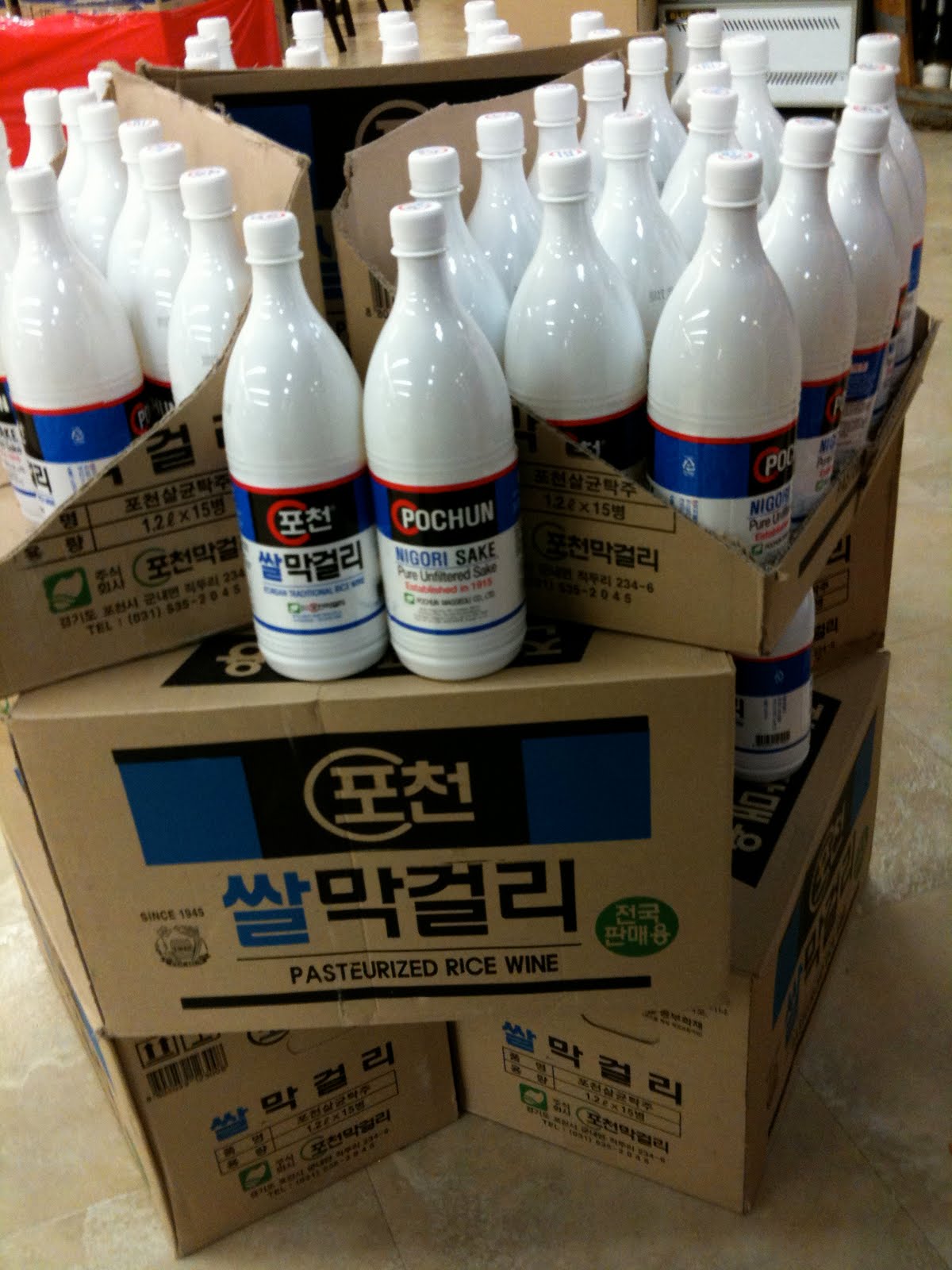
This 10w30-style arrangement reminds me of a store display of motor oil--in what looks like milk bottles, to really mix things up--but it's actually sake. At $2.95 a bottle, I'm betting this is not the premium stuff. We found it sitting next to the quick-grab items by the checkout, far, far from the proper wine and alcohol section. Wacky!


After discovering what freshly-made tofu was all about on my recent trip to Thailand, I was eager to take some of that lovely, whisper-soft stuff home with me. My introduction to fresh, hand-crafted tofu is as big a revelation as sampling my first proper baguette in Paris. I picked up several ingredients from the market and trotted right home to make myself a great pot of miso soup.

These chrysanthemum leaves are sweet, delicate and quick cooking. They add a welcome freshness--miso can be a very wintery tasting soup. They also provide a nice balance to a salad made with bitter greens. Their versatility guaranteed that I got several meals out of them. I'm eager to return to the market to sample their other greens, most of which I've never encountered in the usual grocery chains.

Lotus lace! These poached lotus root slices come bagged and ready to either crunch on or cook into a dish. They remind me in flavor and texture of a firmer jicama.

 Brown rice ovalettes don't look like much, but cooked into broth they make a nice alternative way to enjoy rice-as-usual.

I used all those ingredients and made a big pot of soup with a miso base. Velvety and crunchy, sweet and salty, it was a nice Part II to my Korean food adventure.

By the way, a package of miso paste is a great thing to have on hand. It lasts forever and is your ace in the hole if you need something warm and nourishing and you only have a few odd bits of food to work with. Just dilute a spoonful of miso in some water on low heat and chuck into the pot whatever you have in the fridge. Well, it's not quite as haphazard as that, but I just want to make the point that it's not at all complicated to make a good pot of soup if you keep some miso in stock.

Pickled garlic and kimchi are two mainstays of Korean cuisine; I can't get too much of either one of them! I bought pint jars of these at my local farmers' market, where a Korean man vends a nice selection of homemade goodies. Now whenever I crave a blast of flavor, all I have to do is reach for them. I ramped up the flavor in my pot o' soup by pouring in a little of the kimchi juice.

It's fascinating to see how manners vary, depending on where you are. They seem so very arbitrary. Drinking from your bowl is permissible in a Korean restaurant. But blowing your nose at the table is considered rude, even thought it's running because of all those hot peppers you just ate! I guess the smart thing to do is always to keep an eye on those around you and act accordingly.

Tuesday, June 22, 2010

Week #40 Venetian

At play in a Venetian mask maker's shop...

The Republic of Venice was its own sovereign entity for well over 1,000 years, during which it was THE gateway into Europe for spices and all manner of exotic foods from Asia. So this former city-state, along with the surrounding Veneto region, has a cuisine that certainly merits its own entry. In addition to all those ingredients that flowed in by the shipload, Venice also has strong culinary influences from eastern Europe, particularly Austria and the western Balkans.

Himself and I treated ourselves to a feast at Tre Venezie in Pasadena, a lovely restaurant that is owned and operated by a Venetian chef who is passionate about the cuisine of his homeland. We did a lot of sharing so that we could sample an array of dishes, beginning with an antipasto of seafood and polenta.
The pesce in saor to the left is branzino, served in a lightly sweet and slightly sour sauce. It's not as stout as ceviche, which is marinated in an acid (usually citrus), but the idea is the same--to preserve the fish. In this case the fish is cooked and served cold in a sweetened wine and vinegar reduction. The polenta ovals on the right are topped with baccala mantecato, mousse made of cod (yes yes, I remember that line about whipped fish in an early and very funny episode of Friends!). This solidly Venetian dish includes ingredients like currants and pine nuts that arrived on merchant ships from the Middle East.

Then we shared a couple of primi. The first, cjalsons, is a special dumpling that, depending on the season and what's available, could contain absolutely anything. Traditionally reserved for special occasions, it's an ancient dish from Carnia, a mountain village north of Venice. I must say having cjalsons WAS the special occasion! These delicate little pasta pouches contain ricotta, figs, chocolate and cinnamon, and are more of a dessert than a savory. Rich and enchanting and distractingly good. We were tempted to cancel the rest of our order and beg for a couple more plates of cjalsons.


The next primo was blecs al tacelenghe, that is noodles with beef cheeks braised in tazzelenghe wine, which we also ordered to go with the meal. Blecs are irregularly shaped noodles. These are made of barley, so they have some heft and texture to them. This dish and the wine are both native to the Veneto and also to Friuli and Giulia. In fact, the word "blec" is Slovenian for "piece of cloth," Slovenia being the nextdoor neighbor. The word "tazzelenghe" is Italian for "tongue cutting," on account of the wine's high level of acidity and tannins, but it's really not that strident. It was an excellent foil to the richness of the braise.

Then we shared a secondo of merluzzo nero, that is, black cod poached in a cappuccina sauce of onions, raisins, pine nuts and anchovies. While this is a traditional recipe from the Veneto and Trentino, which lies to the northwest of Venice, the cod is sitting on a bed of new potatoes, reminding us once again of all the directions those ships came from returning with new and wondrous foods (both potatoes and corn came from South America).

Showing the Austrian influence, our dessert was a strudel made with apples and pears, and seated in a pool of plum brandy from Bosnia Herzegovina, Venice's neighbor on the eastern shores of the Adriatic. I'm always impressed with strudel, since I know what's involved in making it. It took a dozen of us in culinary school to stretch that dough nice and thin across two work tables pushed together, and then to fill it and roll it. This was the best strudel I've had yet, with the brandy playing a nice supporting role and not overpowering the fruit. And it certainly looked neater than our student efforts!

Back at home I decided to make one of the region's signature dishes, risi e bisi, that is, risotto with peas. This part of Italy doesn't see as much pasta as you find elsewhere throughout the country. The region is low lying and amenable to rice production, so the preferred starch is risotto (and also corn, in the form of polenta). That's Parmigiano-Reggiano grated over the top. As the name attests, this cheese comes from Parma, just southwest of Venice. Other aged grating cheeses in Italy are called grana. While you may use canned green peas to make this dish, try to get your hands on some fresh ones. They make it so much better. (The recipe is at the bottom of this entry.)

If you've ever made risotto you'll notice that the method for making this dish differs slightly--while risotto is made by stirring the rice into hot butter (or olive oil or a combination of both) and then gradually stirring in the hot broth, with risi e bisi you add the rice to hot broth. If the final product is slightly soupy that's just fine, too, and very Venetian.
The classic dessert of Venice is tiramisu. While I've made it dozens of times, I'm including a photo not of my own, but rather one under construction during a stay in the Veneto, because of the intensity of the custard's color. This rich gold is in stark contrast to the pale yellow that you usually find in tiramisu made in the United States, where most eggs are mass produced and their tiny creators not provided with a suitably rich diet. These were absolutely stunning, and they made this dish truly eye popping (and tongue popping? Does that even make sense?!)
Here's Himself laying into those Italian egg yolks--you can get a little glimpse of what a brilliant orange they are.

All this talk of Venice is making me want to dust off one of my fav movies ever, one set in Venice, Pane i Tulipani, that is, Bread and Tulips. Time to pour myself a glass of wine and crank up the DVR to again watch Rosalba run away to Venezia. Arrivederci!


Risi e bisi (Risotto with Peas)
Yields about 4 to 6 servings

2 oz. pancetta, minced (or an equivalent amount of thick-sliced bacon)
1 lb. young, fresh peas (or frozen & thawed if they're not in season)
leaves of one bunch of fresh Italian parsley (that's the flat-leafed variety; it tastes better than the curly kind), chopped (I toss the stems into the hot stock for some extra flavor--just don't stir them into the rice.)
1 1/4 cups grated Parmigiano-Reggiano (if you opt for pecorino, scale back on the salt)
1 1/2 cups Arborio or another short-grain rice
3 Tbsp. unsalted butter
About 4 cups of hot beef stock or broth (keep it on stove top on very low heat)
1 onion, small dice
salt & freshly ground black pepper

Melt 2 tablespoons of butter in a large sauce pan over medium heat and sauté the bacon, onion and parsley until the onion is translucent. Add the peas and stir until they're combined with the other ingredients. Add a cup of the hot stock, increase the heat to medium high and bring to a boil, stirring. Add two more cups of hot stock, bring to a boil and then stir in the rice. Reduce the heat and cook, stirring frequently until the rice is al dente (with just a slight resistance to the tooth, NOT chewy!). Add more stock if you need to.

Remove from the heat and stir in the last tablespoon of butter and a cup of the grated cheese. Use the rest of the cheese to garnish. Enjoy with a medium dry white wine.

Thursday, June 17, 2010

Week #39 Moroccan

One of the many reasons I would love to visit Morocco is to venture into a souq and see first hand the mountains of spices, to smell their heady aromas and luxuriate in the exotic atmosphere that my-oh-my certainly does look appealing on all those travel shows. It's just a step across the Strait of Gibraltar from Spain, so trekking to Morocco would certainly be doable next time Himself and I hightail it to the Continent.

For a preview of what we might expect to find on the table, our friends Pat and Aaron invited us to dinner at Sassi in Encino for a meal that was not only Moroccan but kosher as well. As is our custom, we ordered several items and ate family style. Their young daughter, Gabriella was game for it the adventure, a real trooper. No kid chow for THIS intrepid gal! That made the evening even better--who knew eight-year-olds like mushrooms?!

Morocco may be in North Africa, but its cuisine contains a hefty blend of Mediterranean and Middle Eastern influences. If you know those cuisines, there will be a familiarity as you delve into your meal, just with a heavy dose of spices.


We started with a platter of fried kuba, little semolina footballs filled with ground beef; pastels, triangular filo pockets filled with potato; falafel, fried balls of ground garbanzo beans; and Moroccan cigars, which I'd liken to a filo "stogie" filled with ground beef. And a dish of hummus to dredge them all through. You really have to approach these babies with caution, because they're so dense and filling you could easily stuff yourself before the entrées arrive. And they're so good that it's difficult to stop with just one of each. Why does fried food have to be so ridiculously satisfying?

The myriad little dishes of salads on the table reminded me of our Israeli meal. We had carrot salad and red and green cabbage salads. The fresh crispness of the salads with their lemony essence helped balance those heavy fried goodies we'd just gobbled up. The flat bread, khobz, is thicker and more substantial than other pita-type bread I've had before. It was a good all-purpose tool for dipping, dredging and sandwich building.

We also got an Israeli salad of cucumbers and tomatoes and an entire bowl of olives. These Moroccan olives are cooked in a peppery red sauce and served warm, which cuts their brininess and enhances their flavor. Oh yes, that's a whole baked chicken in the background, a tasty little guy smothered in mushrooms and love.


Variety was the order of the evening, as we opted to have some fish and lamb to go with our roasted chicken and all the rest (I wonder how you say "fixins" in Moroccan?). The super-fresh salmon is cooked in a spicy, garlicky tomato sauce. I could have forgone the rest of the meal to mop up all that pleasantly warm and happy sauce with the khobz.

The roasted lamb was served with a rice and lentil combo called majadra, making it a sort of North African pilaf. You'll have to forgive me, but at this point my full tum and empty brain conspired to make me forget exactly how this lamb tasted--besides good. I plan to return just for the lamb. Oh yeah, and all the rest as well...

A day or two later, once I'd emerged from the food coma, I was inspired to dust off the tagine Himself had given me for Christmas, and to use those lovely brined lemons that came with it. I made a chicken and olive tagine and served it with couscous, a semolina-based alternative to rice. Just as the first order of business with Cajun and Creole cooking is to make a roux, with Moroccan you start by making ras el hanout, a mélange of spices that can be as varied as the tastes and personalities of those who prepare it. However, it is usually some combination of spices including cinnamon, cardamom, clove, coriander, black pepper, cumin and turmeric. With the spices, olives, onions and brined lemons, not to mention the sweet currants and rich pine nuts in the couscous, this plate of food had an awful lot going for it. It came nearer than any dish I've ever had to satisfying the Thai requirement for sweet, salty, sour, bitter and hot in a single dish. Sublime!

One of the secret weapons of Moroccan cooking is brined lemon, which is pure salty, pickled magic. It's made by slitting and stuffing fresh lemons with salt and stashing them in a jar of brine and lemon juice for a few months, which makes them self-pickling. Do this and you elevate those lemons to new heights of culinary usefulness. What the process does is to intensify the lemon quality--not the tartness, as you might expect, but the sheer lemony flavor. It ferments, sort of like kimchi, so a richness develops that makes them a great flavoring agent. If you don't want all that salt, just wash it off.

To accompany the tagine I made a Moroccan orange salad, one of the easiest and yummiest things you can make, and great anytime, regardless of the menu. The genius of this salad is that it's quick, healthy and versatile.
Moroccan Orange Salad
Peel and segment two oranges and place them in a bowl. Remove the pits from four dates, cut them into eighths long ways and add them to the bowl. If you'd like, toss in a few oil-cured olives. Sprinkle over some ras-el hanout, about a half teaspoon, or if you don't have any, use an assortment of any spices that makes you happy--cinnamon, clove, nutmeg and/or my personal favorite, cardamom. Drizzle on a bit of good olive oil and toss. Top it with some chopped fresh mint. That's all there is to it. If you have a few minutes, let it sit on the counter so the flavors have time to cozy up to each other.

This will serve two people, and the recipe is easy to expand to feed more. I find that once I've had this salad with a meal, I don't go looking for dessert.