Showing posts with label horchata. Show all posts

Saturday, August 21, 2010

Week #48 Guatemalan

For our first foray into Guatemalan cuisine, Himself and I found a place with some inspiring history. Amalia's is one of those great storied restaurants that was named for the resourceful woman who opened it. Widowed with several children at the age of 24, Amalia made the best of a difficult situation by expanding her informal food production into a restaurant that became an anchor in its community. It's a lovely neighborhood gem located a couple of blocks from L.A. City College, a mid-city bungalow converted into a restaurant, with a spacious patio where the driveway and port cochere used to be. That's where the band was set up, too. They had live music when we were there for lunch. Good live music.

Himself's lunch looked back at us, as the sopa de camaron, or shrimp stew, arrived with a large prawn regarding us with a look of beady-eyed indifference. Just below the surface lurked about a half dozen jumbo-sized shrimp that were fresh, plump and juicy. The broth itself tasted of fresh seafood, with none of the staleness that usually accompanies seafood broth from a box or can.

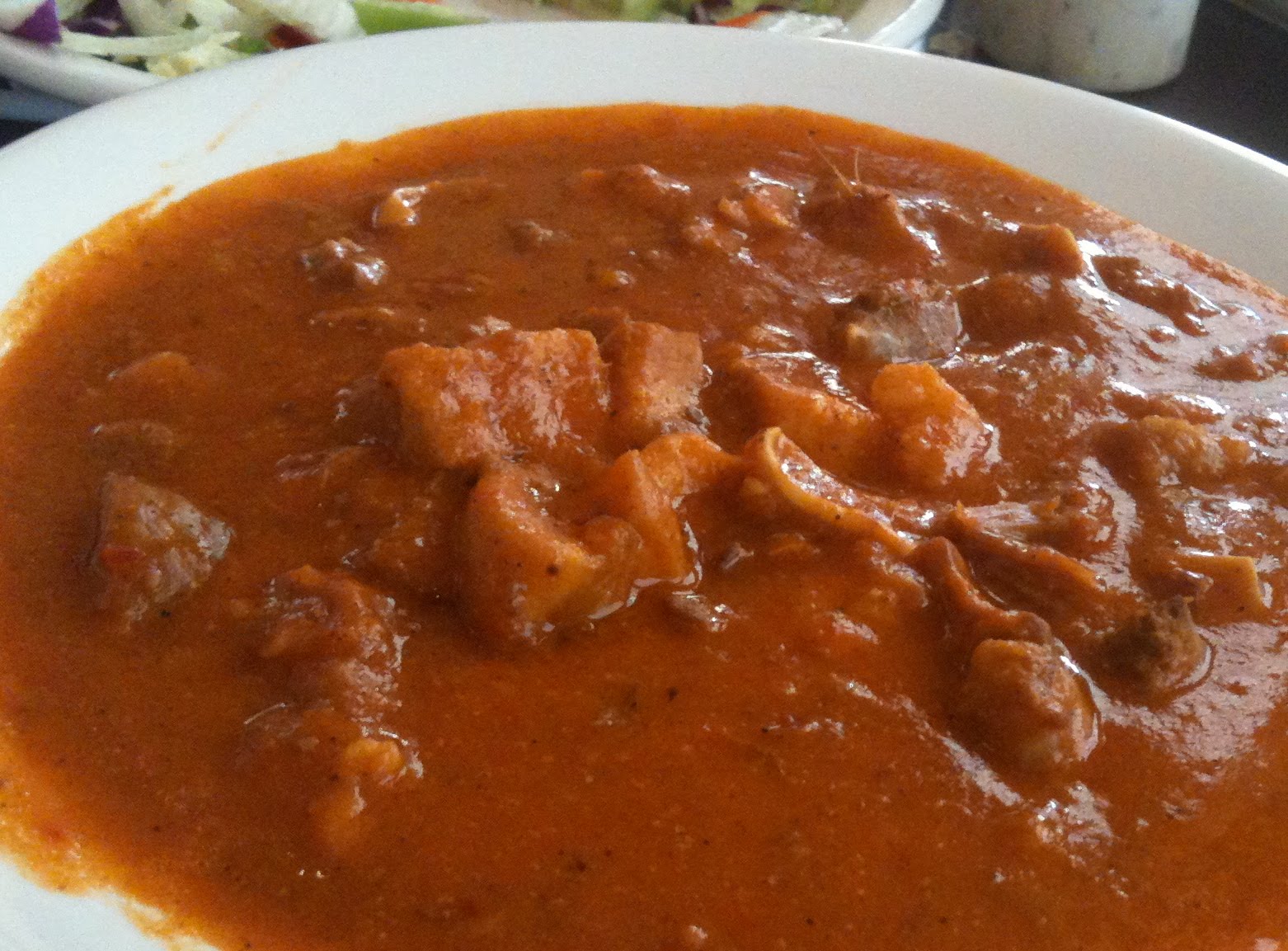
I ordered a generous bowl o' pig parts in a rich tomato broth, a.k.a. revolcado--crunchy ear, delicate heart and earthy liver. I know this isn't for most of you, and quite frankly, it's not really for me either. But I felt the need to try something that is considered an ordinary, everyday dish in Guatemala, where they eat a lot of innards and odd bits we don't usually find on the menu in the United States. After I got past the first cartilaginous ear, chomping on the rest of them was really rather fun (I know my dear friend Mark will roll his eyes when he reads this, since he has "texture issues" concerning foods.). But once you take your time and get acquainted with an unfamiliar texture, the squeamishness can dissipate at least a little. The soup itself was quite good, really rich, roundly seasoned and mildly spicy. The pieces of heart had fat attached, which, because it was pork, was good. Still, it would be nice to experience the texture of the heart itself without the added padding. Well, I'm glad for the experience. And glad it's behind me now.

While this isn't the most inspiring picture, I'm including it for two reasons: One: I've never had refried beans made of black beans. These were really good, much richer in flavor and more satisfying than those made with pintos. Two: Behold the bits of veggie in the rice. They actually used fresh vegetables, cut up and cooked that day, not the uniform-peas-and-carrots-from-a-can. I appreciate little touches like this. Usually I don't eat the rice that accompanies such meals, because all too often it's flavorless and flecked with tired vegetables that taste like aluminum. But this rice was made with broth rather than water and loaded with fresh veggies. We picked all the seafood out of Himself's bowl, so we carried home the rest of the seafood broth and stirred in the leftover rice for a great lunch the next day.

I'd be hard pressed to call a tortilla voluptuous, but these were thick and pliant--made with lard, of course. They reminded me of the exterior of a pupusa. One was all I needed to satisfy. And that means more to carry home and enjoy later with a grating of cheese and a little tomatillo salsa.

 We washed it all down with glasses of jamaica and horchata. You've seen pix of them on this blog before, but they're here again as a reminder that when you go out for Central or South American cuisine, you really should order a beverage that goes with it, not the default soft drink. It helps round out the authentic dining experience. Jamaica (pronounced hah-MY-kah, just in case you've never had it) is a sweetened drink made by boiling dried hibiscus blossoms (be sure to buy the ones specifically intended for consumption, otherwise you might end up with pesticide breath). And horchata is a lightly sweetened drink made from rice (it can also be made from almonds) and seasoned with cinnamon.
Dessert was wicked-good but put us both into a summer afternoon's coma shortly thereafter--and we shared this order! Rellenitos de platano are large fritters made of plantain with mole inside. They were incredibly rich without being overly sweet. Guatemala is a neighbor of Oaxaca, the region of Mexico that gave us mole. Turns out they have it in the country that is Mexico's "south of the border" too, which makes sense, since the entire Mesoamerican region is where the cocoa plant comes from.

No canned food. No canned music. The passion of people who love the cuisine of their home and are eager to share it. The opportunity to further explore the world's foods and see how the web of food and flavoring knits itself together around the globe. This is what I love about authentic restaurants. You just can't get this experience in a chain.

Wednesday, March 3, 2010

Week #24 Oaxacan (Mexican)

Lately this "52 Cuisines" project has been heavily weighted toward Asian food--obviously the blog itself has been!--so it's time to visit a different hemisphere for awhile and explore another of Mexico's many cuisines.

The cuisine of Oaxaca, in southern Mexico, contains a dizzying blend of indigenous ingredients, like chocolate and peppers, with the Arabic contribution of nuts, raisins and spices brought to the region by Spanish explorers. (Our hemisphere repaid the favor by sending tomatoes, potatoes, corn, chocolate and peppers to the rest of the world. Not a bad trade, I'd say.)

Antequera De Oaxaca is a modest little restaurant on Melrose between Koreatown and Paramount Pictures. This strip of Melrose has tons of great finds, and Antequera is the place to go for Oaxacan food cooked by Oaxacans for Oaxacans. I met Pat for lunch there, and we sampled an array of eats, with an eye toward carrying home plenty of leftovers.

Black beans are popular in Oaxaca, sometimes simply smashed and smeared over a tortilla.
 Pat ordered what looked a bit like a Mexican pizza, a giant, super-thin homemade tortilla topped with the smashed black beans, Oaxacan queso, tomato slices, cabbage and avocado. This is about as light and as vegetarian as a Oaxacan meal can get, unless you opt for a very basic salad. A smart choice if you don't want to fall into a postprandial coma at siesta time. Or if you're constantly training for marathons, like Pat is!
  
a quartet of memelas
In the memelas the black beans were spread on each of these four masa cakes, then topped with Oaxacan cheese and chorizo (12:00), zingy, flavorful chicken (2:00), pork (5:00) and beef (9:00) and a slice of avocado. A pleasantly warm salsa on the table provided a little extra kick. I appreciated our server bringing the  memelas with this assortment of meat so we could sample them all. The chorizo was surprisingly mild, while the chicken was the one that carried a surprising punch.

The masa cake is a flat bread roughly the size and shape of a hamburger bun bottom, and while it didn't feel at all greasy, toasted on a grill, I'm sure it was loaded with lard, so lush was its texture. Crispy on the outside and soft on the inside, with a nice bit of char from the grill. Okay, so that's not umami--I wonder what it is in the carbony flavor that so appeals? I think I could have eaten an entire basket of masa cake and been quite happy.
 Stew made from goat ribs--all those little bones give the broth extra richness.
I just had to give the goat stew a try. It was tasty and only a wee bit gamy. A generous squeeze lime helped tame it. It came with a roll of fresh, hot tortillas, so I could fish out hunks of goat meat and make my own tacos with fresh onions, jalapenos and cilantro.

  
Horchata: a rice drink that is lightly sweet and refreshing. This one had pecan pieces and chunks of cantaloupe in it.

While Oaxaca has a diverse cuisine to match its diverse landscape, it's probably best known as "the land of the seven moles" (although there are many more) and we're not talking little animals. This region's cooks are the ingenious souls who took chocolate and made something savory with it.
  
These don't look like much, but they're the secret to great mole. At 2:00 is poblano, a red chile mole base; at 6:00ish is pepita, or pumpkin seed, and at 9:00 is almond.
A typical mole recipe calls for about two dozen ingredients, but it can contain even more. Making it is understandably a labor intensive endeavor, so you have to set aside a day to do nothing but roast and toast, chop and pulverize and mix, so you can make enough mole to last a really long time. It's fun to do in a group, and the effort is worth it. If you dissolve a couple of generous spoonfuls of one of these pastes in a little broth, you'll quickly create the most wonderfully flavored, richest sauces you can imagine. Pour it over the meat of your choice, or drizzle it over an enchilada or into a taco. It's bliss. Forget the bottled stuff--try making your own mole sometime. Be sure and invite over some eager friends to help share in the chores and the rewards.


I have a trio of moles on hand (they're in the photo above) that I picked up at L.A.'s Central Market, a downtown treasure trove not only of fresh produce but of authentic Mexican eats. The green mole is made of pepitas (pumpkin seeds) and is mildly spicy. The almond mole is redolent of toasted almonds and packs some heat, while the poblano mole is chocolaty-good and contains the heat and smokiness of an array of dried chiles.


There's a more obscure mole called manchamanteles, a.k.a. the "tablecloth stainer," because it's made with lots of charred tomatoes. I've not found this one yet, but I'm eager to try it, with lots of napkins!
Chicken mole tamale: a rich, happy-making treat wrapped and cooked in a banana leaf. This time the mole is on the inside rather than the outside. A squeeze of lime helps balance the richness.


We're not even scratching the surface here on Oaxacan cuisine. There are chapulines--crickets--which were not on the menu the day we went to Antequera De Oaxaca. I had them a couple of years ago on a jaunt to Mexico, so if you want to read about it, check out my blog entry on chapulines and huitlacoche. 


My colleague and friend Nancy Zaslavsky is passionate about Mexico and its food. If you want to learn more about the cuisine of Oaxaca--and if you want to visit and learn to cook the local specialties--check out her culinary tours of Mexico. She's been carrying guests to Mexico for years now and teaching them to cook authentic Mexican food on its home turf.

Thursday, May 22, 2008

Mex Without the Tex

At the end of a tiny strip mall in Memphis’ Wolf River basin is Las Tortugas Deli Mexicana, where the Magallanes family brings authentic Mexican food to a city in which most so-called Mexican restaurants serve up things a citizen of that country would never recognize as his homeland’s cuisine.

Forget the Tex-Mex, the nachos and the cheese dip. Forget the mediocre entrée flanked by too much rice and flavorless refried beans that most likely came from a can. This is the real stuff, prepared by a personable family who love sharing not only their native food but the back-story of the food as well.

Small but clean and bright (and with a lunchtime line that trails out the door), this eatery serves up freshly-made specialties that anyone from Mexico City would recognize.

Pepe, the patriarch, explains that the twice-cooked pork ribs are made from his grandmother’s recipe. How can I not try them?! and have them on the second visit? and on the third? They’re superb, the meat falling off the bone so cleanly I can accomplish my post-meal lipstick reapplication in my reflection. Superb mole in homemade mini tortillas, fresh, wonderful tamales, both chicken and pork. And corn on the cob that you wouldn’t believe, beginning with fresh—not frozen—corn, that’s perfectly cooked, then coated with a thin layer of mayonnaise and sprinkled with grated cotija, an aged cow’s milk cheese, and red pepper.

Pepe and his son Jonathan are warm, friendly and hospitable hosts. As I trot to the pick up area when my number is called, Jonathan reaches across a case filled with cheeses, chili peppers and long curls of cassia bark to explain each item I’ve ordered.

Of course, you need a real Mexican beverage to go with your feast. Their agua fresca, fresh fruit drinks, will make you forget all about your favorite soda. Horchata, jamaica, mango, watermelon, limonata and tamarino are just a few, all made fresh and all made really, really good (hey, I’ll shove a clean straw into the glass of anyone who will allow me a taste!).

Tomorrow Andy and I venture to Mexico City to spend a week visiting friends, seeing the sights and enjoying the local cuisine. We look forward to learning more about authentic Mexican food. Of course, just as Italy’s food is regional, so is Mexico’s. But as happens everywhere, folks from the country venture to the city, and some of them open restaurants where their fellow transplants can go for a taste of home. So we anticipate finding at least a smattering of the country’s regional dishes to enjoy while we’re in its capital.

So until our return, hasta luego!